In shortShukkeien garden in Hiroshima was laid out from 1620 as the villa garden of the lord Asano Nagaakira, to a design by his chief retainer and tea master Ueda Soko. The gate opens at 9:00 and closes at 18:00 from 16 March to 15 September, at 17:00 from 16 September to 15 March, with last entry 30 minutes before closing either way.
1620Garden laid out from
9:00-18:0016 March to 15 September
9:00-17:0016 September to 15 March
30 minutesLast entry before closing
The history: a lord's villa garden from 1620
Genna 6, which is 1620, is the date on the garden. Hiroshima's lord Asano Nagaakira had it laid out as the garden of his villa, and the garden's official site credits the design to Ueda Soko, his chief retainer and a tea master. The same ruling house held Hiroshima Castle, which is why the castle quarter and the garden quarter still read as one piece of the city.
One idea runs through the layout: a wide landscape compressed to the scale of a private garden. The pond sits at the centre with islets in it, the paths run the whole way round the water, bridges carry you from bank to islet, and tea houses stand where the view arranges itself. The tea master's trade shows in that last part, since a garden built for tea is built to be walked slowly and stopped in, and the buildings mark the stopping points.
Shukkeien opening hours and admission
The gate opens at 9:00 in both seasons. Closing moves with the calendar: 18:00 from 16 March to 15 September, 17:00 from 16 September to 15 March. Last admission is 30 minutes before closing either way, so in the winter season you want to be through the gate by 16:30. The changeover dates land in the middle of the month rather than at the start, so check the official hours for the exact day you are going.
Admission is handled at the entrance in three categories: general, a reduced rate for university students, and a separate one for elementary, junior-high and high-school students. Nothing has to be arranged in advance, which is what makes the garden easy to drop into a day otherwise built around the park and the museum.
Walking the pond circuit
The walk is one loop with the pond beside you the whole way, over bridges, past the tea houses, up and down low planted rises. There is no route to choose and no reason to double back, and most people are round it in less time than they would give a museum. It fits the first hour after opening, or the last stretch before the gate closes, without pushing anything else out of the day.
What changes is the planting. Hiroshima's cherries normally flower on 25 March and reach full bloom on 3 April, which is the busiest reason to come. Autumn runs later than visitors expect: ginkgo turns yellow around 15 November and Japanese maple around 22 November, by which point the garden is already on its 17:00 closing and the afternoon light goes early. In August, with daily highs averaging 32.8C, take the garden at 9:00 or in the final hour.
Half a day with the castle and the art museum next door
The Hiroshima Prefectural Art Museum is the building beside the garden, at the Shukkeien-mae tram stop, which makes the pairing the obvious one. It runs 9:00 to 17:00 with last admission half an hour before closing, and Friday evenings extend to 19:00 until 31 March 2027. Garden first, museum afterwards, works in both of the garden's seasons.
Hiroshima Castle fills out the block, with one caveat worth knowing before you plan around it. Treat the castle as an outdoor stop here: deteriorating concrete and ageing building services took the main keep out of use in March 2026, and the city has announced no date for letting visitors back in. The reconstructed Ninomaru buildings are open, and the keep exterior and the Ninomaru are both illuminated from sunset until 22:00. That is the reason to walk back through this quarter after dinner.
Do the three as one block: the garden at opening, the museum at the same stop, then the castle grounds, and the illumination later if you are staying the night in the city.
| Place | Opening hours | Last entry |
|---|
| Shukkeien | 9:00-18:00, 16 March to 15 September; 9:00-17:00, 16 September to 15 March | 30 minutes before closing |
|---|
| Hiroshima Prefectural Art Museum | 9:00-17:00 daily; Friday late opening until 19:00 up to 31 March 2027 | 30 minutes before closing |
|---|
| Hiroshima Castle Ninomaru | 9:00-17:30 April to September; 9:00-16:30 October to March | 30 minutes before closing |
|---|
| Hiroshima Castle illumination | Sunset until 22:00 | - |
|---|
Put the garden quarter in a private day
Eight hours with a licensed local English-speaking guide and 3 to 4 sites you pick from the operator's itinerary list, which is how the garden, the moat and the park land in the same day without you timing the connections.
★ 4.9/5 · 1,610 reviews
Getting to Shukkeien-mae
By tram, start at Hiroshima Station's south exit from A platform 1, 2 or 6, change at Hatchobori onto the Hakushima Line and get off at Shukkeien-mae, which leaves you at the entrance. Hiroden trams sell no tickets on board and you pay as you get off, so keep your IC card or your coins in your hand at the door.
The sightseeing loop bus is the other way in, and it starts from the Shinkansen exit of the station. Chugoku JR Bus replaced the three colour-coded routes with a single reorganised route on 18 July 2026, and that route now calls in order at the Hiroshima Prefectural Art Museum, Hiroshima Castle, the Hiroshima Museum of Art, Genbaku Dome-mae, Heiwa Koen-mae and Namiki-dori Iriguchi. It runs every day from 9:00 to 18:00, 42 trips, at intervals of 10 to 15 minutes. The art museum comes first on the loop, so a 9:00 bus puts you at the garden gate before the rest of the quarter fills up.
Guided or by bike between the garden and the castle
The ground between the garden, the castle moat and the park is flat, and two tours on this site cover it in different ways. A bike morning takes the whole centre in one sweep. A private day lets you name the stops, which is the only way to be sure the garden quarter is in the plan.
Hiroshima in a Nutshell: Morning Bike Adventure runs 3 to 4 hours as a first overview of the flat city centre, from 11,000 yen, 4.9 ★ (617 reviews). Bike, helmet, bottled water and an English-speaking guide are included; hotel pickup and gratuities are not. The group forms at 4-5-4 Otemachi, Naka-ku, 730-0051.
The private option counts here for one reason: you name the sites. Hiroshima & Miyajima in 1 Day: Private Tour, Licensed Guide gives you 8 hours with a licensed local English-speaking guide who meets you on foot in Hiroshima, and the walking itinerary is built from 3 to 4 choices on the operator's list, from 30,900 yen, 4.9 ★ (1,610 reviews). Transport, the ferry, entrance fees and lunch are listed as optional and not included, and groups cannot be combined.
- A morning on two wheels across the level city centre with an English-speaking guide: 3 to 4 hours, from 11,000 yen, 4.9 ★ (617 reviews)
- Your own choice of 3 to 4 sites at your own pace with a licensed guide: 8 hours, from 30,900 yen, 4.9 ★ (1,610 reviews)
- Both meet in Hiroshima, so neither one spends a day on travel
Questions people ask
Is Shukkeien worth it in the rain?
The circuit is outdoors from start to finish, so a wet day costs you the long views across the pond. Between about 6 June and about 19 July, the normal rainy-season window for this region, expect rain or cloud for at least part of your visit; July alone averages 279.8 mm. The Prefectural Art Museum sits at the same tram stop, open 9:00 to 17:00 with last admission 30 minutes before closing, so swap the order and wait out the shower indoors.
Can I see Shukkeien and Peace Memorial Park on the same day?
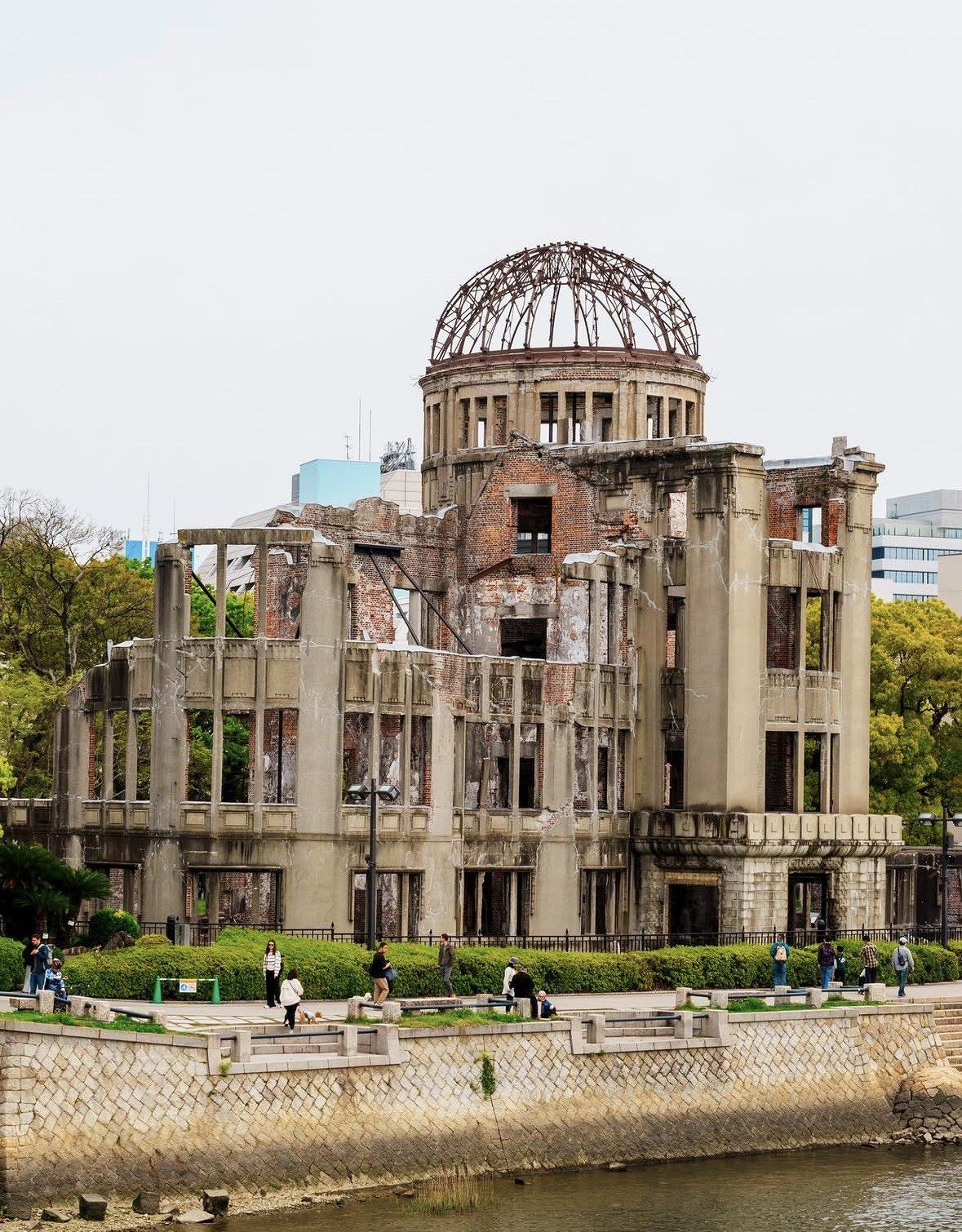
Yes, and the garden is the easier half to place. The park sits on the Genbaku Dome-mae side of the centre and the garden on the Hakushima Line branch at Shukkeien-mae, with Hatchobori as the change point between the two. The loop bus from the station's Shinkansen exit links both quarters on one route, calling at the Prefectural Art Museum before it reaches Genbaku Dome-mae and Heiwa Koen-mae.
Cherry blossom or autumn colour for the garden?
Cherry blossom is the shorter and more precise window: flowering normally starts on 25 March, full bloom on 3 April, with April averaging a daily high of 19.8C. Autumn colour arrives around 15 November for ginkgo and 22 November for Japanese maple, and October averages 23.7C. Autumn gives you easier temperatures and short afternoons, since by then the garden closes at 17:00 with last entry at 16:30.
Do any of the tours on this site include the garden?
The private day is the one that can: 8 hours with a licensed local English-speaking guide, and you choose 3 to 4 sites from the operator's itinerary list, from 30,900 yen, 4.9 ★ (1,610 reviews). Entrance fees are listed as optional rather than included, so garden admission is settled at the entrance. The 3 to 4 hour bike morning covers the flat city centre instead, from 11,000 yen, 4.9 ★ (617 reviews).
What time should I leave the garden to see the castle the same afternoon?
Work back from the Ninomaru, which closes at 17:30 from April to September and at 16:30 from October to March, with last entry 30 minutes earlier. In the winter season that means finishing with the garden by mid-afternoon. Miss it and the keep exterior and the Ninomaru are still illuminated from sunset until 22:00, so the castle quarter holds up as an evening walk.
Read also