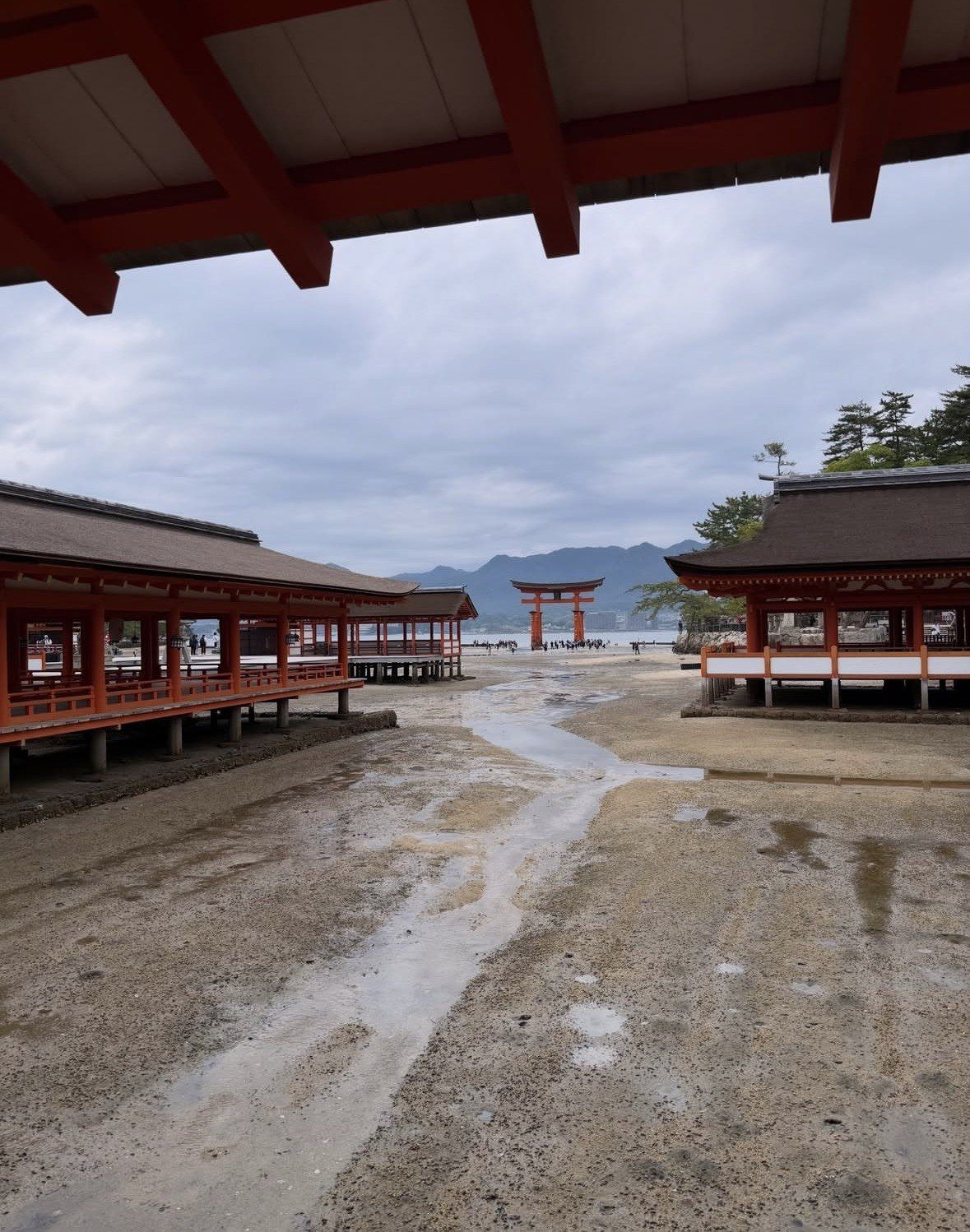
The Origins: A Sacred Island and a River Delta
Hiroshima's recorded story begins offshore, on the island now called Miyajima. Itsukushima Shrine dates its founding to 593, the year Empress Suiko acceded, and the island itself was long treated as sacred rather than simply as the place where a deity lived, which is why the main buildings stand out over the water instead of on dry ground. The shrine took the form visitors recognise today in 1168, when Taira no Kiyomori rebuilt it in shinden-zukuri, the aristocratic residential style of the Heian court, with covered corridors linking separate halls across the shallows. Those halls are a designated national treasure. The Treasure Hall, holding objects gathered over that long patronage, opens 8:00am to 5:00pm all year.
On the mainland, the delta gave the city its shape: flat ground, many channels, and a castle planted in the middle of them. Under the Asano lords the castle town spread across the sandbanks, and in Genna 6, which is 1620, Asano Nagaakira began laying out Shukkeien as his villa garden a short walk from the keep. The design is credited to his chief retainer Ueda Soko, a tea master, and the garden still reads that way: a circuit path around a pond, small bridges, views composed one at a time. The castle's reconstructed Ninomaru buildings open 9:00 to 17:30 from April to September and 9:00 to 16:30 from October to March, with last entry 30 minutes before closing.
Miyajima, the Tide and Mt. Misen
Itsukushima Shrine changes appearance twice a day. The Miyajima Tourist Association publishes a daily tide table giving the exact windows when the shrine appears to float and, separately, when the Great Torii can be approached on foot across the sand. On many days there is no torii-walk window at all, which is worth knowing before you fix the shape of your afternoon. Check the table for your date and build the island half of the day around it rather than around whatever hour looks convenient. Senjokaku, the large hall at Hokoku Shrine on the rise above the shrine complex, keeps steady hours of 8:30am to 4:30pm all year, so it works in either tide state.
Closing time on the island moves with the calendar, and the autumn-colour weeks have the shortest afternoons. According to the shrine's own site, Itsukushima Shrine opens at 6:30am and closes at 6:00pm from 1 March to 14 October, its longest season; from 15 October to 30 November and again from 4 January to the end of February it closes at 5:30pm, and through December at 5:00pm. On 1 January it is open from midnight until 6:30pm for New Year worship. Japanese maple normally colours around 22 November in Hiroshima, so the island's busiest period falls exactly when the gates shut earliest. Hours can be adjusted at short notice, so check on the day.
Mt. Misen rises behind the shrine, and the ropeway that serves it is a morning and early-afternoon affair. Uphill service runs from 9:00 to 16:00 with the last descent at 16:30, and it is two linked lines: Momijidani uses 8-person cabins at one-minute intervals for a ten-minute ride, then Shishiiwa carries 35 passengers a car at intervals of 5 to 15 minutes for four minutes. A shuttle bus to the Momijidani station runs from 9:50, roughly every 20 minutes. The upper station is not the summit; the observatory is about a kilometre further on foot. Three marked trails climb from town in about 1.5 to 2.5 hours, the Daisho-in route listed at two hours. Periodic inspection closes the ropeway completely, and wind or thunder can suspend it.
Dates and Figures Behind Hiroshima's Heritage
593
Year Itsukushima Shrine dates its founding, when Empress Suiko acceded
1168
Taira no Kiyomori rebuilds the shrine in shinden-zukuri style
1620
Shukkeien laid out as Asano Nagaakira's villa garden, designed by Ueda Soko
1 April 1954
Peace Memorial Park completed
145
Entries in the competition the park design was chosen from
5 December 1996
Atomic Bomb Dome inscribed as World Heritage at the Mérida committee meeting
The 1954 Park Design and World Heritage Listing
Peace Memorial Park is a designed landscape rather than an open square. It covers approximately 122,100 square metres where the rivers divide, and it was completed on 1 April 1954 to a plan by three architects including Kenzo Tange, chosen first out of 145 competition entries. The layout works as one axis: museum, cenotaph and the Atomic Bomb Dome line up, so the ruin reads as the end of a sightline instead of an object standing in a field. Walking that axis in order takes only a few minutes and explains the park better than wandering it. The Dome's skeletal brick and steel frame has been held in a stabilised state rather than rebuilt.
UNESCO inscribed the Atomic Bomb Dome on the World Heritage List on 5 December 1996, at the committee meeting held in Mérida, Mexico, and Itsukushima Shrine was registered the same year. That pairing is why one day across the two sites became the standard Hiroshima itinerary. The Hiroshima Peace Memorial Museum, at 1-2 Nakajima-cho in Naka-ku, keeps longer days than most printed guides suggest: 7:30am to 7:00pm from March through July and again from September through November, until 8:00pm in August and until 9:00pm on the 5th and 6th. From December to February it closes at 6:00pm. Entry to the permanent exhibition during the early-morning and late-evening extension windows requires an online reservation.
Beside the museum, the Hiroshima National Peace Memorial Hall opens at 8:30am and closes at 6:00pm from March to November, 7:00pm in August and 5:00pm from December to February. It has no public parking apart from spaces for visitors with physical disabilities, and the institution itself asks people to arrive by public transport. Elsewhere in the city the picture shifted in March 2026, when Hiroshima Castle's main keep closed because of deteriorating concrete and ageing building services. The keep is not scheduled for demolition, its exterior can still be viewed, and the keep and Ninomaru are illuminated from sunset until 22:00. Hijiyama Park gained Japan's first public museum devoted to contemporary art on 3 May 1989, designed by Kisho Kurokawa.
Hiroshima Today: Living Heritage
Hiroshima today is easiest to read from a tram window. Hiroden runs nine services, the L loop line among them; from Hiroshima Station, routes 1 and 5 head for Hiroshima Port, route 2 for Hiroden-Miyajimaguchi and route 6 for Eba. Genbaku Dome-mae is about 25 minutes from the station, plus a walk of around 10 minutes. No tickets are sold on board and you pay as you get off, which catches first-timers out. The Meiple-loop sightseeing bus starts and finishes at the station's Shinkansen exit and, since the routes were reorganised on 18 July 2026, calls in order at the Prefectural Art Museum, Hiroshima Castle, the Hiroshima Museum of Art, Genbaku Dome-mae, Heiwa Koen-mae and Namiki-dori Iriguchi, 42 trips a day between 9:00 and 18:00.
Evenings belong to the food. Hiroshima-style okonomiyaki is layered rather than mixed: a thin crepe base under cabbage, meat or seafood, fried noodles and an egg, a style credited to Mitchan Sohonten. The prefecture produces more oysters than any other in Japan, small, slightly sweet and low in liquid, which is why they arrive grilled on izakaya counters in Nagarekawa, reached directly from the Ebisucho or Hatchobori tram stops, and in Ekinishi west of the station. Near Miyajima-guchi, anago-meshi is the dish people queue for. Come in the first days of June for Toukasan, on 6 August for the Peace Memorial Ceremony, or on 18, 19 and 20 November for Ebisu Taisai, and allow the city more than a single day.