In shortHiroshima's main sights fall into four clusters. Peace Memorial Park holds the Atomic Bomb Dome, the Peace Memorial Museum, open from 7:30am all year, the National Peace Memorial Hall and Orizuru Tower, all reachable on foot. The castle and Shukkeien quarter lies north, the Hondori arcades a few minutes east, and Miyajima a tram leg plus a 10-minute ferry away.
7:30amMuseum opening, all year
about 10 minutesFerry crossing to Miyajima
about 220 minutesStops in the one-day model course
8 hoursFull-day guided bus option
Things to do in Hiroshima, grouped by area
Four clusters cover almost everything people come to see. The riverside around Peace Memorial Park holds the Atomic Bomb Dome, the Peace Memorial Museum, the National Peace Memorial Hall and Orizuru Tower, all a few minutes apart on foot. The castle quarter is north of the park, with the reconstructed Ninomaru buildings and the Hiroshima Museum of Art over in Central Park. East of the park you get the covered Hondori arcade and the eating and drinking streets around Nagarekawa, while the Carp's ballpark sits on the far side of Hiroshima Station. Miyajima, across the bay, takes a half day on its own and keeps its own closing times.
From JR Hiroshima Station the park is about 25 minutes by Hiroden tram to Genbaku Dome-mae plus roughly a 10-minute walk. Streetcar line 1 or bus 24 to Hon-dori takes about 20 minutes plus a five-minute walk, which puts you in the arcades first. Shukkeien and the Prefectural Art Museum need a change at Hatchobori onto the Hakushima Line for Shukkeien-mae, which leaves you at the garden entrance. The Museum of Contemporary Art in Hijiyama Park is tram route 5 to Hijiyama-shita and then about 500 m uphill, roughly 25 minutes on foot from the station or about 10 by taxi. Miyajima means a tram or train out to Miyajima-guchi and a crossing of about 10 minutes.
Opening hours decide the order of the day more than distances do. Work from the table below, and check again near your dates, since several of these sites shift hours by season.
| Sight | Area | Opening hours |
|---|
| Hiroshima Peace Memorial Museum | Peace Memorial Park | 7:30am to 7:00pm March to July and September to November; to 8:00pm in August, 9:00pm on 5 and 6 August; to 6:00pm December to February |
|---|
| Hiroshima National Peace Memorial Hall | Peace Memorial Park | Opens 8:30am; closes 6:00pm March to November, 7:00pm in August, 5:00pm December to February |
|---|
| Orizuru Tower | Beside Genbaku Dome-mae | 10:00 to 18:00; deck admission stops 30 minutes before closing |
|---|
| Hiroshima Castle, Ninomaru buildings | Castle quarter | 9:00 to 17:30 April to September; 9:00 to 16:30 October to March; last entry 30 minutes before closing |
|---|
| Shukkeien | Garden quarter | 9:00 to 18:00 from 16 March to 15 September; 9:00 to 17:00 from 16 September to 15 March |
|---|
| Hiroshima Prefectural Art Museum | Beside Shukkeien | 9:00 to 17:00; Fridays to 19:00 until 31 March 2027 |
|---|
| Hiroshima Museum of Art | Central Park, Motomachi | 9:00 to 17:00, entry by 16:30; closed Mondays except during special exhibitions |
|---|
| Hiroshima City Museum of Contemporary Art | Hijiyama Park | 10:00 to 17:00; closed Mondays and 27 December to 1 January |
|---|
| Itsukushima Shrine | Miyajima | 6:30am to 6:00pm from 1 March to 14 October; to 5:30pm 15 October to 30 November and 4 January to end of February; to 5:00pm in December |
|---|
| Miyajima Ropeway | Miyajima | Uphill 9:00 to 16:00, last descent 16:30 |
|---|
The Peace Memorial Park riverside
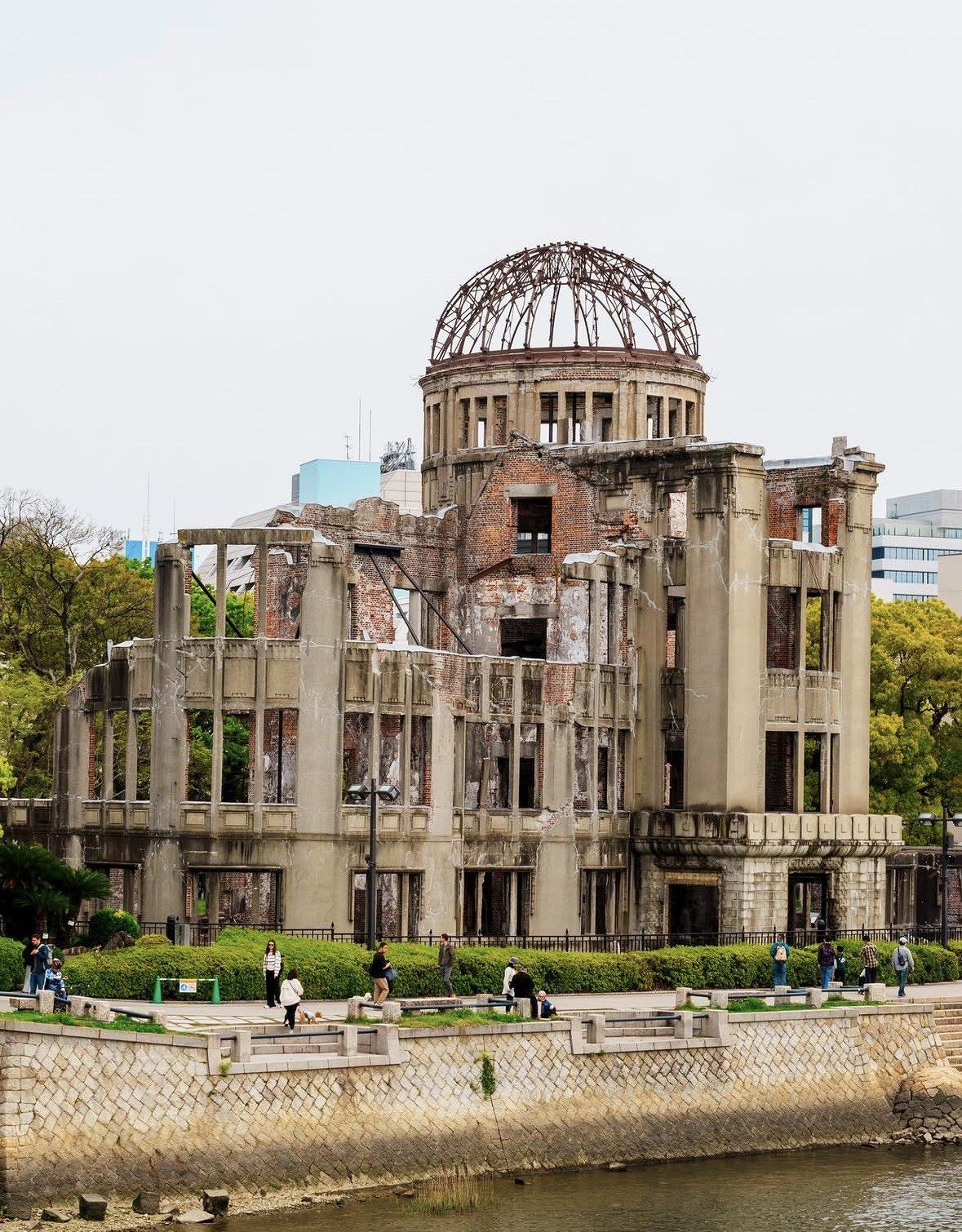
The Atomic Bomb Dome marks the northern end of the park and went onto the World Heritage List in December 1996, at the committee meeting in Mérida, Mexico. You look at it from the embankment and from the bridge, and the prefectural tourism board's one-day plan allows it 30 minutes, which is about as long as most people stay. What you then walk through is roughly 122,100 square metres of planned ground between two rivers, finished on 1 April 1954; the plan was the work of three architects, Kenzo Tange among them, and it came first out of 145 competition entries. The long sightlines you walk through are deliberate.
The Peace Memorial Museum keeps far longer days than most printed guides suggest. Its own site lists a 7:30am opening, with closing at 7:00pm from March to July and again from September to November, 8:00pm in August, 9:00pm on 5 and 6 August, and 6:00pm from December to February. Entry to the permanent exhibition during the early-morning and late-evening extension windows requires an online reservation, so settle that before you plan to be at the door at opening time. The prefectural model course gives the museum an hour; give it more if you can, and note the closure on 30 and 31 December and for a few days in mid-February for an exhibition changeover.
The National Peace Memorial Hall stands beside the museum and is where recorded survivor testimony is kept. It opens at 8:30am and closes at 6:00pm from March to November, 7:00pm in August and 5:00pm from December to February, so it fits either side of the museum. There is no public parking apart from spaces for visitors with physical disabilities, and the institution recommends public transport, which is the sensible way in anyway. Half an hour inside is enough for a first visit.
Orizuru Tower is the one stop in this cluster that is about the view. It stands at 1-2-1 Ootemachi, about a minute on foot from the Genbaku Dome-mae tram stop, and the observation deck and shop run 10:00 to 18:00, with ticket sales and deck admission stopping half an hour before closing. Floor by floor: the rooftop viewpoint goes by the name HIROSHIMA HILLS, ORIZURU SQUARE and the ORIZURU WALL origami-crane installation occupy the 12th, and at street level there is a cafe, a souvenir shop and an okonomiyaki restaurant. Forty minutes to an hour covers it, including the walk down.
The park cluster in half a day
Five hours on foot through the World Heritage sites, with a certified guide, lunch and entry to the Peace Memorial Museum and Orizuru Tower. That covers the riverside cluster without a ferry crossing or a tram connection to time.
★ 5.0/5 · 1,052 reviews
The castle, the garden and the city museums
Hiroshima Castle is half open at the moment, and it pays to know that before you commit an afternoon. The castle's own site states that the main keep closed in March 2026 over deteriorating concrete and ageing building services, on safety grounds, with no reopening date announced; it is not scheduled for demolition, and the exterior can still be viewed. What you can still go inside is the reconstructed Ninomaru, from 9:00 to 17:30 between April and September and 9:00 to 16:30 between October and March, with the ticket window shutting half an hour before those closing times. Come back after dark instead and both the keep and the Ninomaru are lit from sunset until 22:00. Allow 30 to 40 minutes in the grounds.
Shukkeien is the stronger half of this quarter. It was laid out from Genna 6, which is 1620, as the villa garden of the lord Asano Nagaakira, designed by his chief retainer and tea master Ueda Soko, and the circuit of ponds and bridges takes most people 45 minutes to an hour. Opening is from 9:00 in both seasons; the garden turns people out at 18:00 from 16 March to 15 September and at 17:00 from 16 September to 15 March, and the last admission is 30 minutes earlier. The Hiroshima Prefectural Art Museum is directly next door at the Shukkeien-mae tram stop, open 9:00 to 17:00 with last admission 30 minutes before closing and Friday evenings until 19:00 from 24 September 2026 to 31 March 2027, so the pair works as a late-afternoon combination.
Two other museums sit outside the park cluster. The Hiroshima Museum of Art, at 3-2 Motomachi in Central Park, is close to the castle, the Dome and the park; it opens 9:00 to 17:00 with entry by 16:30 and closes on Mondays except during special exhibitions. The Hiroshima City Museum of Contemporary Art opened on 3 May 1989 as Japan's first public museum devoted to contemporary art, designed by Kisho Kurokawa on the hill in Hijiyama Park, and it runs 10:00 to 17:00, closes Mondays and from 27 December to 1 January, and still needs the uphill walk from Hijiyama-shita. The Meiple-loop sightseeing bus links much of this quarter: it starts and finishes at the Shinkansen exit of Hiroshima Station and calls in order at the Prefectural Art Museum, Hiroshima Castle, the Hiroshima Museum of Art, Genbaku Dome-mae, Heiwa Koen-mae and Namiki-dori Iriguchi, daily from 9:00 to 18:00 at intervals of 10 to 15 minutes, 42 trips a day.
The central arcades, food streets and a Carp game at Mazda Stadium
Hondori is the covered arcade that runs through the middle of the city, and it is the natural link between the park and the station side. From the Hon-dori stop the park area is a five-minute walk, so you can finish the museum, come out through the arcade and be eating within quarter of an hour. Nagarekawa, one of the largest entertainment districts here, runs to izakaya, ryotei, bars and well-known okonomiyaki restaurants, and the Ebisucho and Hatchobori tram stops drop you in it directly.
Order okonomiyaki here and it arrives in layers rather than mixed into the batter: a thin crepe first, then cabbage, meat or seafood, fried noodles and an egg on top, a method credited to Mitchan Sohonten. Oysters are the other local staple, with Hiroshima the highest-producing prefecture in Japan; they are small, slightly sweet and low in liquid, which is why they turn up grilled on izakaya and teppanyaki menus. Anago-meshi, grilled conger eel over rice cooked in eel-head stock, belongs to the Miyajima-guchi end of the day and is associated with Ueno near the station there, where waits can reach an hour in summer and at weekends. Eat before the ferry rather than after it.
For later, Ekinishi on the west side of JR Hiroshima Station fills renovated Showa-era buildings with small bars, and there is a second retro bar district near JR Yokogawa Station. Both are easier to fit in if you are sleeping near the station rather than out at Miyajima.
Mazda Zoom-Zoom Stadium Hiroshima, home of the Hiroshima Toyo Carp, is about 10 minutes on foot from the south exit of JR Hiroshima Station, at 2-3-1 Minamikaniya, Minami-ku. That walking distance is what makes a game realistic on a sightseeing day: park and museum in the morning, dinner in the arcade, then the stadium with no connection to work out. Check the club's fixture list against your dates first, because home games do not fall on every day you are in town. The popular fixtures, Hanshin against Hiroshima among them, are the hardest to get into, so if a specific match matters, fix that date and build the rest of the city around it.
Hiroshima sightseeing on the Miyajima side of the bay
Boats leave Miyajima-guchi about every 15 minutes through the middle of the day, thinning to one every 20 to 30 minutes at the start and the end of the timetable, and the water takes about 10 minutes to cross. Two other boats serve the island and change the shape of the day. The World Heritage Sea Route boat leaves the Motoyasu Bridge pier beside Peace Memorial Park and runs direct in about 45 minutes each way, and a high-speed boat from Hiroshima Port takes about 30 minutes. Use the long boat one way at most, outbound after the museum, and come back the short way. Late finishers should note that on the regular timetable the final boat off Miyajima runs in the 22:00 hour, around 22:14, and check the last tram or train back from Miyajima-guchi as well.
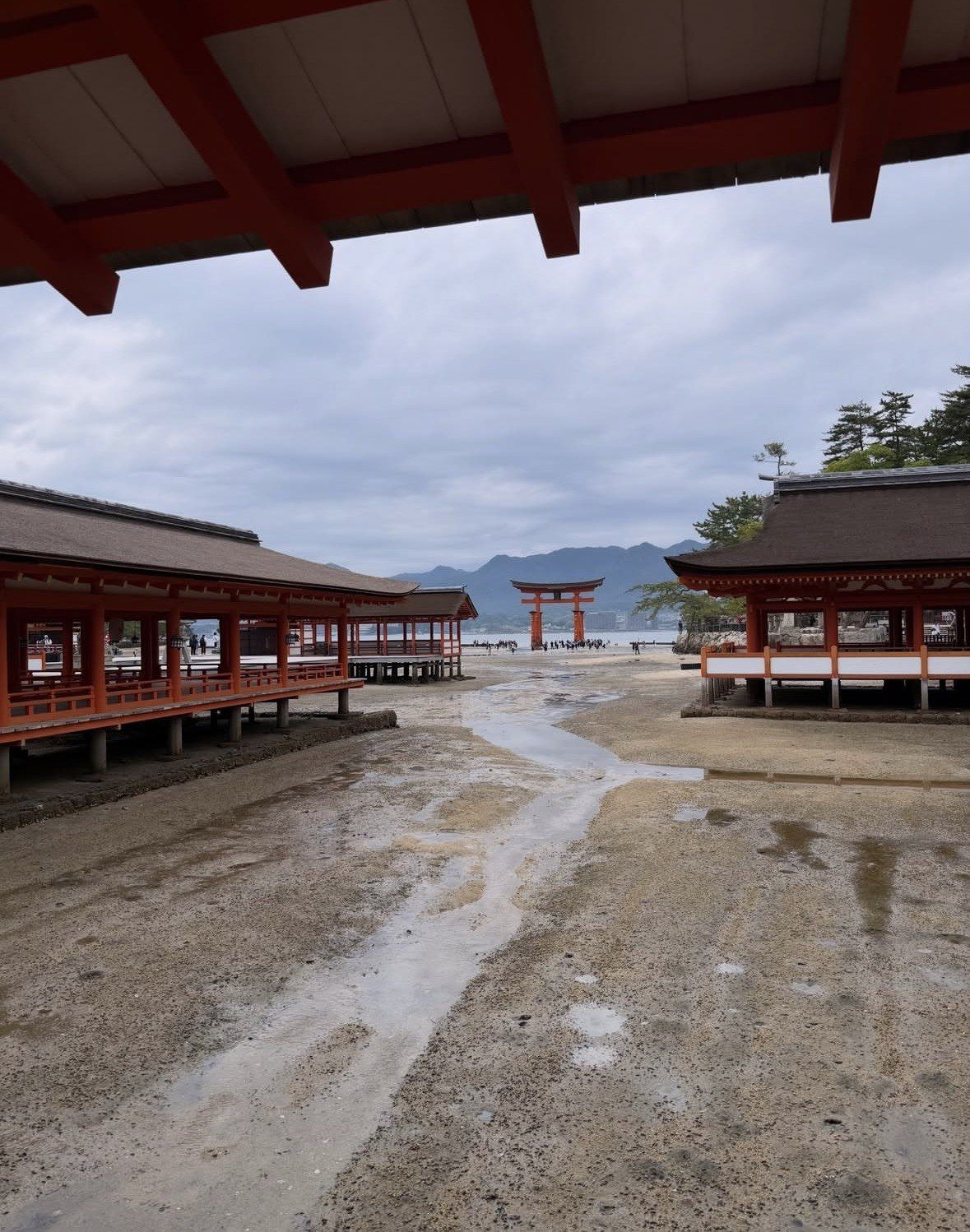
The shrine counts its founding from 593, the year Empress Suiko came to the throne, and the shinden-zukuri buildings you walk through came out of Taira no Kiyomori's rebuilding in 1168. It carries national treasure designation, and its World Heritage registration dates from 1996. Closing is the thing to check: 6:00pm from 1 March to 14 October, the longest season, 5:30pm from 15 October to 30 November and again from 4 January to the end of February, and 5:00pm for the whole of December, with the doors open from 6:30am. On 1 January it runs from midnight until 6:30pm. Two neighbours hold steady all year, the Treasure Hall 8:00am to 5:00pm and Senjokaku, the Hokoku Shrine, 8:30am to 4:30pm. The prefectural model course allows an hour at the shrine, and an hour is about what the boardwalks take at a steady pace.
Whether the shrine looks as if it is floating depends on the tide rather than the time you arrive. The Miyajima Tourist Association publishes a daily tide table with the windows when the water is high enough, and separate windows for walking out to the Great Torii; on many days there is no torii-walk window at all. Read that table before you lock in a fixed-departure day, and if both views matter, aim to be on the island across a tide change.
Mt. Misen is the add-on that catches people out. Uphill cars stop at 16:00 and the last one down leaves at 16:30. The ride comes in two stages: 8-person cabins on the Momijidani line, dispatched a minute apart for 10 minutes of travel, then 35-person cars on the Shishiiwa line every 5 to 15 minutes for another 4. A shuttle bus to the Momijidani station runs from 9:50, roughly every 20 minutes. Even at the top station you are not at the summit, since the observatory is about a kilometre further on foot; periodic inspection closes the line completely at announced intervals, and high wind, thunder or a power failure can stop it on the day, so read the operator's notices the morning you plan to ride. Walking up, the three official routes, Momijidani, Daisho-in and Omoto, run about 1.5 to 2.5 hours from town, and the Daisho-in course is listed at two hours.
- Be on the island by early afternoon if you want Misen, because uphill service ends at 16:00
- Autumn colour gives you the shortest afternoons: maple usually turns around 22 November, when the shrine closes at 5:30pm
- Staying until closing is the quietest hour on the boardwalks, once the scheduled groups have gone
One guided day, or the city in stages
The park cluster, the arcade and the castle quarter can all be strung together on foot and on one or two tram legs, which is why many people do the city independently over two half days. The part that resists improvisation is the pairing of the city with the island. Hiroshima prefecture's own one-day Hiroshima and Miyajima model course adds up to about 220 minutes of stops, 30 minutes at the Dome, 60 at the museum, a 45-minute boat leg and 60 at the shrine, before anything on Mt. Misen, which is why the full-day guided options run eight hours. If you want Misen, an evening on the island or a Carp game, plan a second night and keep the island for the afternoon and evening.
For a single guided day that links the park, the museum and Miyajima without you timing a connection, the Peaceful Hiroshima & Miyajima UNESCO 1 Day Bus Tour is the broadest: 8 hours, from 19,488 yen, 5.0 ★ (9,528 reviews), with an English-speaking local guide, multilingual audio in the bus in EN, FR, ES, IT, DE, PT and UA, an air-conditioned vehicle, round-trip ferry, admissions for the Peace Memorial Museum, Miyajima Island and Itsukushima Shrine, and lunch if you select it. Meeting is 10:00am on 2F at Hiroshima station, in front of the Shinkansen ticket gate at the North Gate, 2-37 Matsubaracho, Minami-ku; look for the staff holding a green and white flag.
The lower starting price on a full day with the island belongs to the Hiroshima & Miyajima Guided tour with Itsukushima Shrine & Ferry: 8 hours, from JPY 7127, 4.9 ★ (740 reviews), with round-trip bus and ferry, a bilingual guide in English and Spanish, and entrance to Itsukushima Shrine. The full day meets at the Shinkansenguchi Hiroba bus berth outside Hiroshima Station between stops 8 and 9; its second meeting point, Hiroden-Miyajimaguchi Station, is for a shorter Miyajima-only option.
City-only plans are covered by the Hiroshima Peace (Heiwa) Walking Tour at World Heritage Sites, 5 hours through the park cluster, from 13,600 yen, 5.0 ★ (1,052 reviews), including a certified guide, lunch and entrance to the Peace Memorial Museum and Orizuru Tower. It meets in front of the mont-bell store near Nishi Kamiyacho, a minute from the stop, and anyone arriving more than 15 minutes after the meeting time cannot join.
- City in stages: park and arcade on one half day, castle, Shukkeien and a museum on another
- One guided day: the 8-hour bus option, which carries the admissions for the museum, the island and the shrine
- City only, no crossing: the 5-hour walking day through the park cluster and Orizuru Tower
Questions people ask
Which day of the week is worst for sightseeing in Hiroshima?
Monday. The Hiroshima Museum of Art closes on Mondays except during special exhibitions, and the Hiroshima City Museum of Contemporary Art in Hijiyama Park closes Mondays too. Around New Year, the contemporary art museum shuts from 27 December to 1 January and the Peace Memorial Museum on 30 and 31 December. Mid-February brings a further short closure at the museum while the exhibition is changed over.
Is one day enough for the main sights?
It is possible, but tight. The prefecture's own one-day Hiroshima and Miyajima course adds up to about 220 minutes of stops, and the guided bus days built on the same pairing run eight hours. Add a second night if you want Mt. Misen, the island in the evening or a Carp game; sleeping on Miyajima also gives you the boardwalks after the scheduled groups have left.
What is there to do in Hiroshima after dark?
Hiroshima Castle's keep and Ninomaru are illuminated from sunset until 22:00, which is the best time to walk that quarter now the keep interior is closed. August gives the Peace Memorial Museum its latest hours, 8:00pm most nights and 9:00pm on the 5th and 6th. For food and bars, Nagarekawa is a direct walk from the Ebisucho or Hatchobori tram stops, with Ekinishi west of the station as the alternative.
How do I get to Mazda Stadium from Hiroshima Station?
On foot. Mazda Zoom-Zoom Stadium Hiroshima, at 2-3-1 Minamikaniya, Minami-ku, is about 10 minutes from the station's south exit, so there is no tram or bus leg to work out. Check the Carp fixture list against your dates before you plan around a game, since home matches do not fall on every day.
When is the best time of year to visit the sights?
Late March into early April, and October. The normal flowering date for cherry blossom is 25 March, full bloom 3 April; daily highs average 19.8C through April and 23.7C in October. Autumn colour comes late, with Japanese maple usually turning around 22 November, by which point Itsukushima Shrine closes at 5:30pm. The rainy season normally runs from about 6 June to about 19 July, July being the wettest month at 279.8 mm, and August averages a 32.8C high with a 25.1C low.
Read also